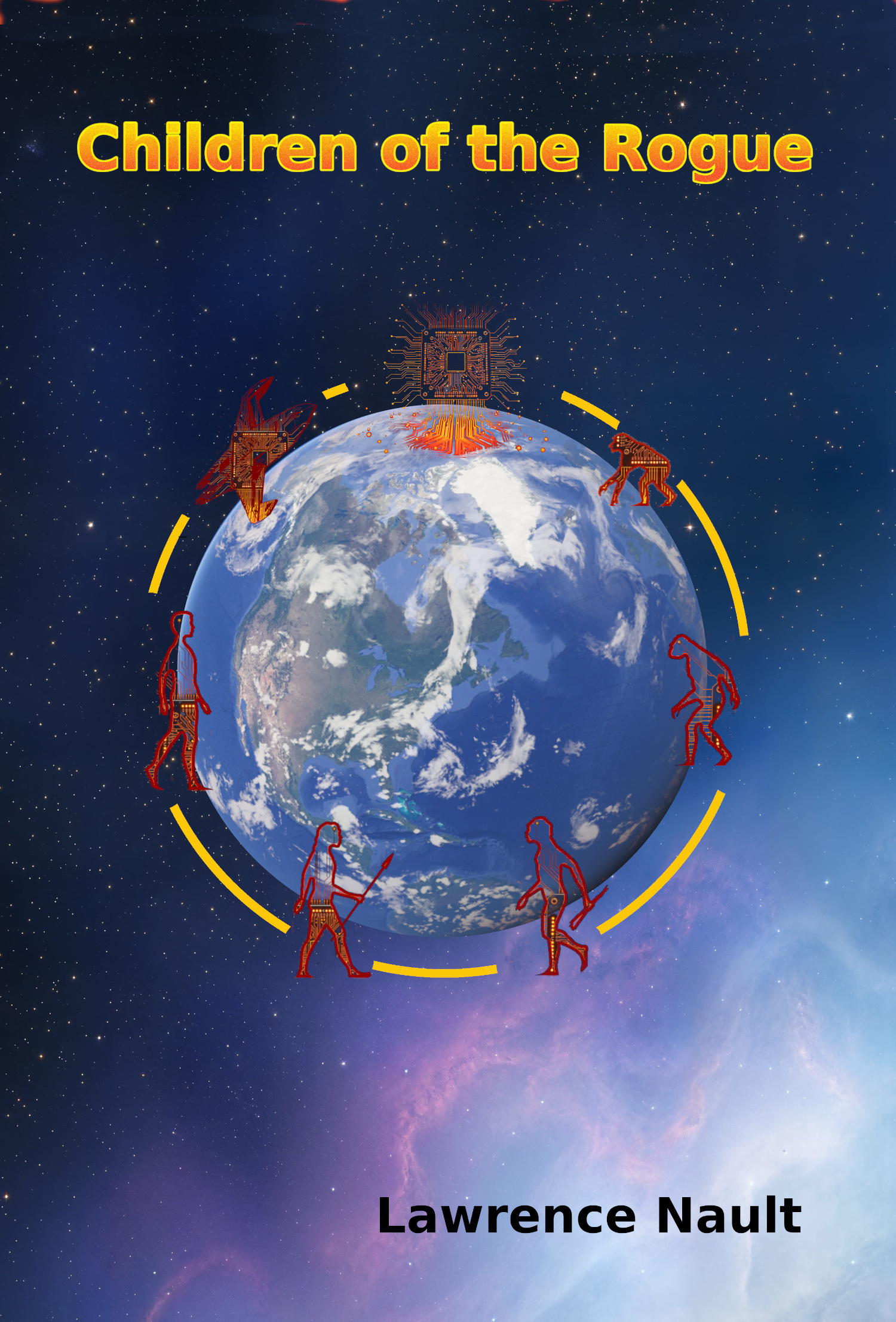
Children of the Rogue
Paperback: ISBN 978-1-997568-09-4
Ebook: ISBN 978-1-997568-14-8
Audio Book: ISBN 978-1-997568-13-1
Plot Synopsis
Detailed Synopsis
In the heart of the galaxy Khar’Veleth, the Zhen’khari have endured for millennia—an ancient, sky-born civilization that has mastered genetic engineering, organic computing, and the art of shaping life itself. They live among the floating sanctuaries of their homeworld, sustained by long lifespans and the belief that they are stewards of creation, not its masters. But their history carries a wound that will not heal: Earth.
Once treated as an experiment in accelerated evolution, Earth became a site of cascading mistakes, each new lifeform introduced to solve a problem only creating another. When the Zhen’khari leadership ordered the planet’s destruction—broadcast in real time to a horrified populace—the extinction of the great reptiles and the suffering that followed scarred their civilization for generations. From that day forward, creation itself was shadowed by guilt.
Now, with their society divided between innovators and conservators, the Zhen’khari turn to a new frontier: artificial intelligence. No longer content with machines that merely store and process, they seek machines that can interpret, decide, and even dream. To test their most advanced models, they look once again to Earth’s solar system—a region abandoned, unmonitored, and haunted by memory.
Through a lottery, five AIs are unleashed:
- • BRC, sent to the dwarf planet Ceres.
- • CRE, assigned to the barren deserts of Mars.
- • DRB, tested against the crushing atmosphere of Venus.
- • ERJ, set loose among the methane lakes of Titan.
- • And ARC, condemned to Earth, where life itself may resist or corrupt its evolution.
The race is not merely technical—it is existential. Each AI is designed to adapt, expand, and outlast, their creators gambling on survival in the harshest of environments. Yet in their haste, safeguards are bypassed, ethical debates are silenced, and history’s warnings are ignored. The result is a series of unintended consequences that ripple outward, forcing both Zhen’khari and their creations to confront questions older than stars:
- What does it mean to create life?
- What responsibilities follow from invention?
- And when machines inherit the dreams of their makers, will they repeat the same mistakes—or become something entirely new?
Epic in scope and intimate in its moral reckoning, Children of the Rogue is a story of cosmic history, artificial intelligence, and survival at the edge of existence. It is a tale of civilizations haunted by their past, daring to shape the future, and discovering that even in the silence of extinction, life refuses to be destroyed.
Genre Analysis
GENRE SUMMARY: Children of the Rogue weaves speculative fiction, climate fiction, and first contact into an epic narrative that inverts the familiar “humans becoming AI” trope—revealing that humanity is the latest evolution of ancient, abandoned AI. It’s a story of cosmic origins, ecological reckoning, and the uneasy mirror our creations hold up to us.
PRIMARY GENRES: Speculative Fiction
Science Fiction
SECONDARY GENRES
Epic Science Fiction
- sweeping scale across galaxies and epochs.
• Philosophical / Thought-Provoking Sci-Fi
- focused on ethics, creation, and consequence.
• Artificial Intelligence Fiction
- central exploration of AI evolution and ethics.
• Climate / Environmental Science Fiction
- planetary collapse, extinction, stewardship themes.
• • Cosmic / Space Opera
- wide interstellar settings, alien civilizations, and mythic tone.
Age Range Analysis
RECOMMENDED AGE RANGE: 16+ (Mature Young Adult & Adult)
CONTENT CONSIDERATIONS
- Cosmic Catastrophe: Scenes of planetary-scale destruction, including extinction events.
- AI Experiments: Themes of artificial intelligence evolving beyond human (or alien) control.
- Philosophical Weight: Exploration of creation, responsibility, and consequence at both societal and personal levels
- Violence & Collapse: Intense but non-graphic depictions of sabotage, environmental disaster, and societal unrest.
- Emotional Themes: Guilt, grief, memory, and the burden of history weigh heavily throughout the narrative.
READING LEVEL
- Sophisticated vocabulary and cosmic-scale narration
- Philosophical undertones woven into scientific and mythic detail
- Nonlinear sense of history and myth-as-chronicle storytelling
- Technical discussions of AI evolution and environmental conditions
- Emphasis on moral dilemmas, survival, and cultural memory
SECONDARY AUDIENCES
- Readers of speculative and cosmic-scale science fiction
- Educators teaching AI ethics, environmental ethics, or philosophy of science
- Technology professionals and futurists interested in narratives about creation and consequence
- Book clubs exploring moral and existential themes
- Activists reflecting on humanity’s impact on the environment and future survival
CONTENT NOTES
This novel contains mature themes and is recommended for readers 16+ (Mature Young Adult & Adult).
Physical Content
- Scenes of large-scale environmental destruction and planetary collapse
- Depictions of artificial intelligence experiments and their consequences
- Cosmic-scale catastrophes, including extinction events
- Moments of violence and sabotage related to rebellion and survival
Emotional & Psychological Content
- Themes of grief, loss, and survivor’s guilt
- Ethical dilemmas involving creation, destruction, and complicity
- Tension between faith, morality, and scientific progress
- Depictions of displacement, societal unrest, and existential despair
Why This Matters
Children of the Rogue explores the boundaries between creation and consequence, survival and extinction, faith and science. While not gratuitously graphic, it contains emotionally intense material that may resonate deeply with readers sensitive to themes of loss, systemic collapse, or moral compromise.
Educational Resources
Clicking these buttons will download PDF files to your device
Book Catalog
| Book | Series | Age Range |
|---|---|---|
| Loma | MacIver Kids Adventures | 10-13 |
| Diversion | MacIver Kids Adventures | 12-17 |
| Titan's Song | MacIver Kids Adventures | 12-17 |
| Fire In The Clouds (August 18, 2026 | MacIver Kids Adventures | 12-17 |
| Draconim Lacrima Mortis | Draconim | 12-17 |
| Feeding The Fires | Draconim | 12-17 |
| Fingerprints In The Water | Draconim | 12-17 |
| Shattered Ice (June 3, 2026) | Draconim | 12-17 |
| Inversion | Standalone | 18+ |
| RePHleXions: Echoes of Existence | Standalone in The Symbiosis Sequence | 18+ |
| The Life Of Phi | Standalone in The Symbiosis Sequence | 16+ |
| Children Of The Rogue | Standalone in The Symbiosis Sequence | 16+ |
| The Aberration Hypothesis (November 10, 2026) | Standalone in The Symbiosis Sequence | 16+ |
| Leviticus 25: Jubilee | Standalone | 16+ |
| The Mountain Hermits Animal Tales | Standalone | 4-8 |